
For decades, the 40-gallon tank was the standard in Chicago basements. As energy costs rise and families grow, more homeowners are switching to tankless water heaters. They're well engineered, but more sensitive to local water than a tank.
Lake Michigan water is safe and high quality, but it falls in the moderately hard range. For a tankless unit, which flash-heats water in a compact heat exchanger, that mineral content creates specific maintenance needs. This guide helps Chicago and Northwest Indiana homeowners manage them, so the unit can approach its full service life.
20+ years: the expected service life of a tankless water heater with proper annual maintenance, according to the U.S. Department of Energy. Skip the maintenance and that figure can be cut roughly in half.
Why tankless units scale
The City of Chicago typically reports hardness around 7 to 9 grains per gallon. When that water is heated quickly to 120°F or more, calcium and magnesium come out of solution and form a hard crust called calcium carbonate.
In a tank, those minerals settle at the bottom. In a tankless unit, they bake onto the fins of the heat exchanger. Scale is a strong insulator, so the burner has to run longer and hotter to push heat through it. That leads to metal fatigue and, eventually, a cracked exchanger. Skipping maintenance doesn't just cost efficiency; it shortens the life of the appliance.
The real cost of skipping maintenance
Scale doesn't announce itself. It builds quietly until the symptoms are hard to ignore.
| Years without a flush | What's happening inside |
|---|---|
| 1 to 2 | A thin mineral film coats the heat exchanger. Efficiency drops slightly, too little to notice. The burner runs a few seconds longer per use. |
| 3 to 5 | Scale thickens. Recovery times lengthen and the unit cycles more. Some homeowners notice brief bursts of cold water mid-shower. Gas use creeps up. |
| 5 and beyond | Scale triggers safety shutdowns, confuses temperature sensors and fouls the flame rod. Hot spots form on the exchanger and eventually crack it. At that point the unit is usually not worth repairing. |
The fix is the same as the prevention: an annual flush. About an hour of maintenance a year prevents the whole cascade. Skip it for five years and you've traded a routine service call for a full replacement, usually on the coldest weekend of the year.
The homeowner maintenance checklist
Some basics you can handle yourself between professional visits.
| Task | How often | Why it matters |
|---|---|---|
| Rinse the air intake filter | Every 6 months | Dust, lint and cottonwood seeds clog the intake. A dirty filter wastes gas and can stall the unit with an error code. Rinse, dry fully, replace. |
| Clean the water inlet screen | During each flush | It catches sediment where cold water enters. Weak hot-water pressure with strong cold-water pressure usually points here. |
| Check the condensate drain | Twice a year | High-efficiency units make mildly acidic condensate. A clogged trap is a common cause of unexpected shutdowns. Follow the line and confirm it flows. |
| Watch for warning signs | As needed | Uneven temperatures, longer waits, white flakes in aerators or any error code deserve a closer look. |
Before you flush: safety check
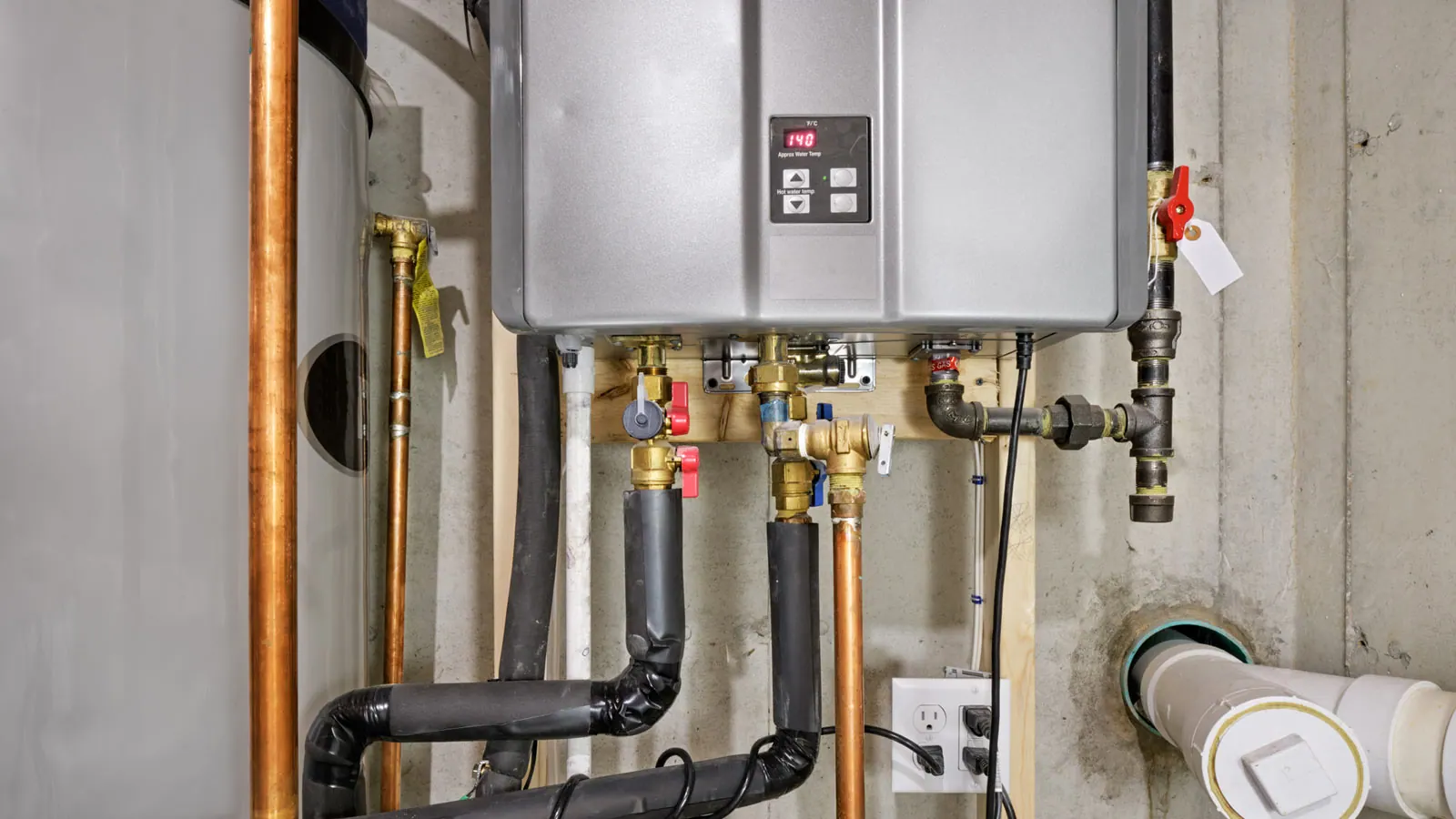
- Confirm you have isolation valves. These red (hot) and blue (cold) ball valves with service ports sit between the water lines and the unit. Without them, a DIY flush isn't practical; a plumber needs to install valves or use bypass equipment.
- Inspect for leaks. Any moisture, mineral staining or corrosion at a joint means stop and call a plumber.
- Ventilate the area. Even food-grade vinegar vapor is unpleasant in a closed basement.
- Plan for the used solution. It's acidic and full of dissolved minerals. Most codes allow a utility sink, but check local rules; some Northwest Indiana communities are stricter.
- Read your manual. Rinnai, Navien, Noritz, Rheem and Bosch procedures and approved descalers differ, and the wrong solution can affect warranty coverage.
Under warranty? Manufacturers almost always require a documented annual flush. A DIY flush counts if you can show it was done, so keep a dated note. A professional service call creates the record for you.
How to flush a tankless water heater
Flushing circulates a mild acid through the unit to dissolve the calcium baked onto its surfaces. You can schedule professional tankless service, or, with the right setup, do it yourself. For a shorter walkthrough, see how to maintain your tankless water heater.
What you'll need
- A 1/6 HP submersible pump rated for warm water and mild acid
- Two 5-foot utility hoses with garden-hose threaded ends
- A 5-gallon bucket, ideally dedicated to this job
- 4 gallons of food-grade white vinegar, or a manufacturer-approved descaler
Step by step
- De-energize. Unplug the unit or switch off its breaker. Turn the gas valve off.
- Isolate. Close the cold water inlet and hot water outlet at the isolation valves.
- Relieve pressure. Slowly open the service port caps. Expect a little spray.
- Set up the pump loop. Connect hose 1 from the pump to the cold service port. Connect hose 2 to the hot service port and let the other end hang in the bucket.
- Circulate. Submerge the pump in the vinegar and plug it in. Run for 45 minutes, longer if your water is harder.
- Purge. Dispose of the solution per local code. Close the cold service port, open the main cold inlet and flush fresh water through for at least 5 minutes, draining out the hot port into the bucket.
- Reactivate. Close all service ports, remove the hoses, open both isolation valves and restore power and gas.
Chicago and most of Cook County sit in the moderately hard range, so a 45-minute cycle is usually enough. Some Northwest Indiana suburbs have harder water and may need 60 to 90 minutes.
Error codes and red flags
Code numbers vary by brand, but these problem categories show up on nearly every unit. For most homeowners, they're the first sign maintenance was put off too long.
| Symptom | What it usually means |
|---|---|
| Ignition or flame failure code | The unit can't light or detect a flame. Often a dirty flame rod, wrong gas pressure or a venting issue. Time for a plumbing diagnostic. |
| Scale or overheat warning | The heat exchanger is running too hot for the water passing through, almost always from scale. Stop and flush. |
| Brief cold bursts mid-shower | Scale on the flow sensor keeps it from detecting small draws, so the burner shuts off briefly. |
| White flakes in aerators | Scale has broken loose inside the unit and is traveling into your supply lines. |
Chicago winters: protect your vents
High-efficiency tankless units produce relatively cool, moist exhaust, usually routed through PVC. In sub-zero weather, that moisture can freeze at the vent and form icicles. If ice blocks the intake or exhaust, the unit shuts itself down. After every major snowstorm, and during January and February deep freezes, check the vents on the side of the house and clear any snow or ice.
What a King tankless inspection covers
A DIY flush handles the scale, but not the mechanical health of the unit. During a professional service call, King's plumbers also check:
- Gas pressure, to confirm the unit gets the fuel it's rated for
- The flame rod, cleaned of carbon that interferes with ignition
- Combustion, testing CO and CO2 for safety and efficiency
- The condensate trap, cleared of debris that causes shutdowns
- The expansion tank, to confirm pressure is managed
- Venting, for proper slope, secure fittings and exterior clearance
Choosing a plumbing company
A service mistake on a tankless heater can mean water damage, a gas safety issue or both. Whoever you hire, look for:
- Local experience. King has served Chicago and Northwest Indiana since 1968 and knows how Lake Michigan water and older two-flats and bungalows affect these units.
- Licensed, bonded and insured plumbers. Unlicensed or unpermitted work can complicate insurance claims and home sales.
- Pricing in writing, before work starts. Ask about service fees and whether the diagnostic applies to the repair.
- 24/7 availability. Vents ice over at 2 a.m., not during business hours.
- Third-party recognition. King holds the BBB Torch Award for Ethics. No single credential proves quality, but together they're a useful filter.
- Specific reviews. Reviews that describe the actual work tell you more than generic five-star ratings.